
Pointe Coupee Parole Versus Probation
Parole and probation both allow a person to live in the community under rules, but they begin in different ways. Parole is conditional release after imprisonment under Louisiana law and the Committee on Parole process. Probation is ordered by a sentencing court. A person may also leave prison through diminution, often called good time, without receiving a discretionary parole grant. The exact judgment and the Louisiana Department of Public Safety and Corrections record control.
| Supervision type | How it begins | Best verification |
|---|---|---|
| Parole | Conditional release after imprisonment under a Board or statutory process | LAVNS status, the parole result, and the assigned P&P office |
| Probation | A sentence or condition imposed by the court | Signed judgment or minute entry plus the supervising office |
| Full discharge | The sentence and supervision have ended | DPS&C discharge date or the controlling court record |
The local roster answers a different question. It shows current displayed custody at the Pointe Coupee Parish Detention Center, not the terms of community supervision. A transfer into state custody can also remove a person from that roster while confinement continues. Use the Pointe Coupee released-inmate search path to identify the custodian before drawing a conclusion.
- Parole
- Conditional release from imprisonment before the full sentence ends.
- Probation
- Court-ordered community supervision instead of, or after, a custody term.
- Discharge
- The formal end of a sentence or supervision term.
- Absconder
- A person whom the supervising agency alleges it cannot locate after noncompliance.
Verify Pointe Coupee Post-Release Supervision
Louisiana uses the statewide LAVNS interface for both imprisoned people and people under probation or parole. That shared coverage is useful after release, but identity matching matters. Search the exact name or ID/case number and compare date of birth or other available identifiers. A community-supervision result differs from a custody result. No match is unresolved, not proof that supervision ended.
- Choose Louisiana and search with the most exact name or ID available.
- Open only the correctly matched record and read whether it reports custody or community supervision.
- Call the DPS&C locator at 225-383-4580 with the DPS&C number, or name and date of birth, to ask for the assigned P&P district.
- Use the official Probation and Parole office directory after the district is known.
- Check the sentencing court record or parole result for the authority and terms, then request a discharge date if the question is whether supervision has fully ended.
LAVNS is updated on the state’s daily reporting cycle, so note the observation date. A public caller may receive only general information from an office. The arrest parish, conviction parish, release address, and assigned supervision district can differ. Never select an office merely because the original case arose in Pointe Coupee Parish.
Pointe Coupee Probation Office Routes
Louisiana Division of Probation and Parole handles state supervision, but the research did not establish one office for every Pointe Coupee case. The assigned district should come from the matched LAVNS record or DPS&C locator. State material says a supervised person reports to the assigned district soon after sentencing or release. That duty does not guarantee broad public access to an individual case file.
Louisiana DPS&C locator and district route
Imprisoned Person Locator: 225-383-4580
Time-computation questions: 225-342-0799
Probation and Parole office directory
A Pointe Coupee misdemeanor can follow a separate court route. The Eighteenth Judicial District Court program serves Pointe Coupee, Iberville, and West Baton Rouge parishes. It is not a public name-search database and is not limited to Pointe Coupee residents. The court’s own record should establish whether that program supervises the sentence.
18th JDC Misdemeanor Probation
745 Michigan Avenue, Port Allen, LA
Mailing: P.O. Box 299, Plaquemine, LA 70765
225-687-5255 or 225-372-2036
Monday through Friday, 8:30 a.m. to 4:30 p.m.
Pointe Coupee Supervision Status Limits
Conditions vary with the judgment, release authority, and supervising agency. They may govern reporting, travel, treatment, or other conduct, but a directory page does not reveal the controlling terms. Obtain the signed sentence or parole documents when exact conditions matter. A community-supervision label confirms neither perfect compliance nor a new violation.
No official Pointe Coupee-specific absconder or warrant list was found. “Absconder” is an agency status alleging that a supervised person cannot be located after noncompliance. It is not the same as being back in custody. A missed appointment, stale address, or old news item cannot establish a warrant. Confirm a claimed warrant through the issuing court or law-enforcement agency and confirm custody through the responsible custodian.
LAVNS registration may report a later status change, but an alert is not a certified court or discharge record. Match the alert to the right person, keep its date, and then check the court, P&P office, or DPS&C source that can explain the change.
When Pointe Coupee Supervision Ends
Release from prison and discharge from a sentence are not synonyms. A person may be out of prison yet remain on parole, probation, or another form of community supervision. Louisiana law generally protects the full prison file, but R.S. 15:574.12(G)(1)(a) makes the discharge date among specified general information available on request. A narrow request for that date is stronger than asking for a confidential file.
For probation, use the court record that imposed the term and any later order ending, extending, or revoking it. For parole, compare the DPS&C status, assigned office, and final discharge information. An absent LAVNS result does not by itself show discharge. Names change, records age out, aliases differ, and reporting can lag.
Pointe Coupee Parole Hearing Records
The Louisiana parole docket page provides weekly notices, archived dockets, and results. The annual hearing calendar identifies likely panel weeks, including parish-level settings. Hearings are generally held by Zoom with the panel at DPS&C headquarters unless a notice says otherwise. Read the current notice because dates and procedures can change.
Use the annual calendar to find a likely week, then search the weekly docket by name or DPS&C number. Check the later result document and quote its action exactly. A scheduled hearing does not mean parole was granted. A grant also does not prove release on the hearing date because a plan, conditions, processing, or a later effective date may remain.
Pardon schedules and minutes are a separate clemency channel. A pardon, commutation, parole grant, release from prison, and full discharge are distinct events. The correct Pointe Coupee supervision conclusion pairs the Board record with later DPS&C status.
Parole eligibility also differs from a hearing outcome. Louisiana R.S. 15:574.4 contains cutoff-sensitive rules, exclusions, and varying fractions based on offense and history. Reaching a threshold only permits consideration for an otherwise eligible person. It does not require the panel to grant release. For newer offenses, the current judgment and governing law must be checked rather than applying an older percentage by habit.
The official Louisiana parole dockets and results page supplies a useful view of those documents. It shows the statewide record channel used for Pointe Coupee parole decisions:
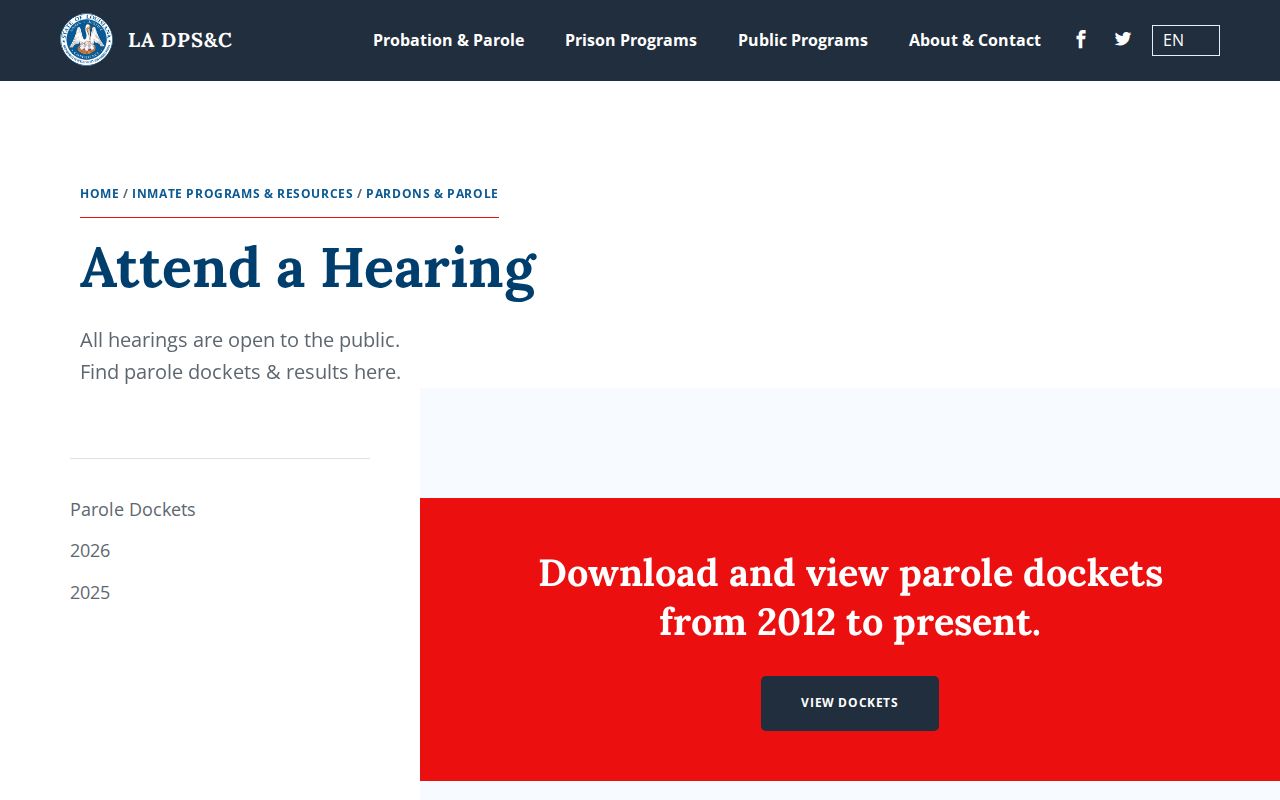
The image documents the source interface, not the status of any person or a completed release.
Pointe Coupee Reentry Support Pilot
Louisiana R.S. 15:745.2 expressly creates an Offender Reentry Support Pilot Program within the Pointe Coupee Parish Sheriff’s Office, led by Sheriff Rene Thibodeaux. The law contemplates an individual transition plan and one point of contact for up to twelve months after discharge. Listed forms of navigation include transportation, treatment, family counseling, health care, child care, and other transition needs.
The statute is a local pathway, not proof that each service is funded now or that every released person qualifies. Ask the sheriff whether the program is active, what intake proof is required, and which services are currently available. Do not treat program enrollment as parole or probation verification. The supervision record still comes from DPS&C or the court.
Identification After Pointe Coupee Release
The same Pointe Coupee reentry law specifically includes help obtaining needed identification documents. That can matter when a released person lacks usable ID for routine post-discharge tasks. The provision supports asking the sheriff-based program about current document help and required proof.
It does not guarantee replacement documents, enrollment, or a set completion time. Keep the request separate from supervision verification. The reentry contact may help with transition needs, while the assigned P&P office and court record answer legal-status questions.
Pointe Coupee Court Supervision Records
The Eighteenth Judicial District Court has original criminal jurisdiction in Pointe Coupee, Iberville, and West Baton Rouge parishes. A district program page may explain how supervision operates, but the Pointe Coupee Clerk maintains the case record for a Pointe Coupee prosecution. Search by name and use the docket number when available. Read minute entries in date order and obtain the signed judgment when exact probation terms matter.
The Pointe Coupee Adult Drug Court is another local form of structured court oversight. The program began in 2006 for qualifying nonviolent participants and combines judicial supervision with treatment and work by the court, law enforcement, prosecution, defense, and state probation. Participation may explain why a person is outside jail under close court control. It is not a public release list or proof of parole.
A bond order, sentence to probation, revocation, or later discharge can each appear in the court record. Yet the court order and physical custody event remain distinct. Another hold can delay departure after an order, while a revocation order can precede the person’s return to custody. Pair the clerk record with the sheriff or DPS&C status before stating that supervision began or ended.