
Pointe Coupee 72-Hour Release Finding
No official Pointe Coupee Parish list limited to the prior 72 hours was located. The parish LAVNS endpoint is an alphabetical current roster. It supplies a live count, a last-updated time, and current entry details, but it does not publish a three-day release window, release reason, release date, or former-record retention policy. Waiting three days between roster visits does not turn it into a release report.
A multi-day review is still useful, but it must be built from official events. Start and end times define the question. The sheriff can then determine whether an existing report covers that range or whether person-specific booking records are needed. Court minutes can explain why custody was expected to end. A receiving system shows whether the person moved into different custody.
Rebuild Pointe Coupee Three-Day Releases
Use a written observation log across the 72-hour span. Note the roster’s timestamp, not just the moment it was opened. Exact names, dates of birth, booking dates, and case numbers make later checks more reliable. For only the current day, the Pointe Coupee Parish 24-hour release page provides the shorter workflow.
- Write down the exact start and end date and time for the three-day interval.
- Check the local LAVNS roster and save the page’s own last-updated time. Search exact names and likely aliases.
- Call the detention center at 225-638-5407 for a named person. Ask whether the person remains there and which custodian can document the event.
- Ask the sheriff’s Civil Division whether an existing release report covers the stated interval. If not, submit person-specific event requests.
- Search the Pointe Coupee Clerk docket for bond, dismissal, probation, time-served, commitment, or release orders entered within the span.
- Follow any transfer into statewide LAVNS, BOP, ICE, another jail, or the actual detaining facility identified by the record.
This approach does not assume that all data arrives at once. A roster observation, court action, alert, and jail event can carry different times. Record each source and timestamp so the sequence remains clear.
Use status language with care. A bond release ends pretrial jail custody under court-set terms, but the charge may remain open. Time served normally reflects a sentence or credit decision. Probation is court-ordered community supervision. A transfer ends the detention center’s custody while confinement continues elsewhere. If the event identifies an ICE or federal pickup, describe it as a handoff rather than a release to the community.
Pointe Coupee 72-Hour Release Fields
The parish has no published 72-hour output to describe field by field. The useful inventory therefore distinguishes what is visible on the current roster from what may be requested in the release record. A current field can support identity or timing of an observation. It cannot be relabeled as a release field.
| Field | Use in a 72-hour review | Limit |
|---|---|---|
| Roster name and date of birth | Match the correct person at an observation point | Does not show why the entry later vanished |
| Arrest date | Ties the displayed person to a likely booking | Is not a release date |
| Roster last-updated time | Dates a current-custody snapshot | Is not an event timestamp |
| Booking number | Links records for one jail stay | Must be requested if not already known |
| Release date and time | Places the event inside or outside the interval | Requires the sheriff event record |
| Release authority and type | Separates bond, court action, sentence end, or transfer | May require both jail and court records |
| Receiving agency | Shows where custody continued | Subject to record availability and lawful redaction |
The request can also ask for bond disposition and transfer destination if those fields are maintained and public. Do not demand a newly made analysis. Ask first whether the custodian keeps a standard report for the exact date range.
Note: The roster’s image or entry link may aid identity matching, but neither one proves release or permission to republish the record.
Pointe Coupee Weekend Release Gaps
A 72-hour period can bridge a weekend, yet official research found no published Pointe Coupee weekend release rule, holiday schedule, public exit location, or fixed processing time. It would be unsafe to claim that a court order entered before a weekend caused physical departure that same day. Jail processing, another charge, a detainer, or a receiving agency can affect the sequence.
Read court minute entries in time order. A bond order or sentence to time served supplies legal authority, while the sheriff event gives physical release timing. When the latest record commits a person to DPS&C, disappearance from the parish roster may signal state-custody processing. Louisiana also houses some state prisoners in parish facilities, so legal custody can change before the person’s physical location changes.
For a named person, the Pointe Coupee Parish release search and records hub lays out the full court, jail, state, federal, and immigration chain. Call the detention center before planning pickup because no official family waiting area or release door was found.
Request Pointe Coupee Three-Day Records
The sheriff is the primary custodian for a Pointe Coupee Parish Detention Center release event. Use the official public-record form. Requests may be mailed to the Civil Division at P.O. Box 248, New Roads, LA 70760; delivered to 128 Court Street; faxed to 225-638-5420; or emailed to PublicRecords@pcpso.org. Questions route to 225-638-5433.
State the interval precisely. Ask whether an existing report lists releases from the detention center between the start and end timestamps. If one exists, request it with required redactions. If it does not, narrow the inquiry to identified people and bookings. The form lists $1 per copied or scanned page, $5 certification, and an estimate before copies are made. Records are not transmitted by email, and payment should not accompany the first request.
A filed court record belongs with the Pointe Coupee Clerk. The District Attorney may hold other records, but its public-record request page, shown below, explains that the office may not be the custodian and that pending matters or protected work product may be withheld.

Use the clerk for filed minutes and signed orders, and the sheriff for the jail’s actual release event. That separation prevents a legal order from being mistaken for a precise departure time.
Pointe Coupee Release Custody Routes
A person absent from the local roster may still be confined. The office of Sheriff Rene Thibodeaux holds the parish booking-and-release event. If that record identifies DPS&C, search statewide LAVNS and call the locator at 225-383-4580 with the DPS&C number or name and date of birth. Statewide LAVNS includes incarceration and community supervision. A community-supervision record supports that prison custody ended, but it does not prove full discharge or the exact release time.
The DPS&C public-information page shown below provides the official state records route when the three-day inquiry crosses from parish jail custody into a state sentence.
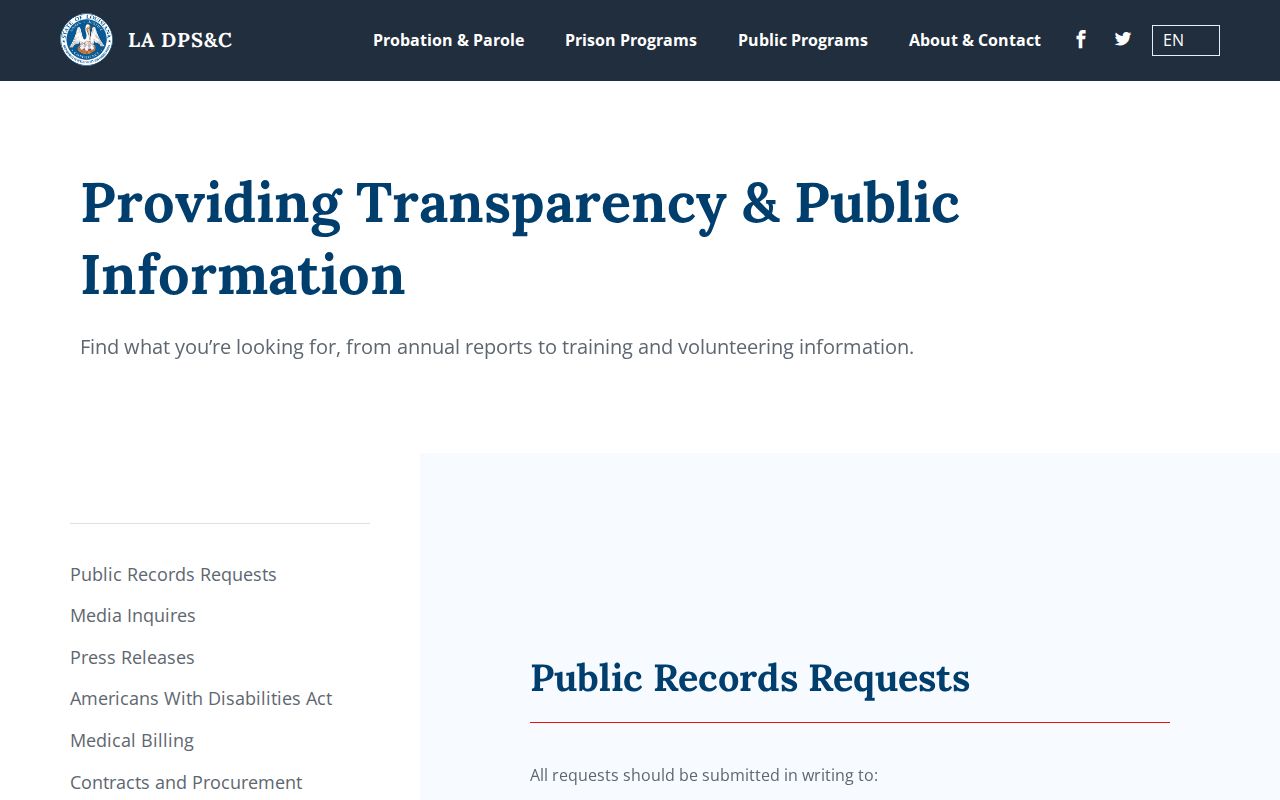
For a narrow public state record, request the discharge date authorized by La. R.S. 15:574.12(G)(1)(a), not the confidential prison file. Discharge is the end of the sentence or supervision and may occur well after release from prison.
A BOP result with a past release date and no facility, or “RELEASED,” means the person is no longer in BOP custody. A federal pretrial defendant may be held through USMS and have no BOP sentenced-prisoner record. ICE uses its own locator, including a limited recent-release window. Each result concerns only that agency’s custody.
Pointe Coupee Release Archive Limits
Pointe Coupee’s local LAVNS page is timestamped and current-custody-first. No official 24-hour or 72-hour archive, release reason, or retention span was found. Nonofficial dated snapshots can show that the visible roster changed between two observations. They cannot identify whether the cause was release, transfer, a hold, or a display issue.
A three-day reconstruction is strongest when it combines an initial observation, a final observation, the sheriff’s event, and the relevant court action. If the event names another custodian, add that system’s result. This produces an evidence chain rather than a guessed list of “who got out.”
Keep each conclusion narrow. “No longer shown on the Pointe Coupee roster” is accurate when that is all the evidence says. “Released to the community” requires a record that rules out continued custody. A no-result across several systems still does not prove full discharge, since records can lag, age out, use another name, or fall outside a portal’s coverage.
Identity details should remain tied to one booking. A person can have more than one jail stay, case, or release event. Full name, aliases, date of birth, arrest date, booking number, and docket number keep the three-day request from combining unrelated events. When exact proof is required for court or legal process, ask whether a certified copy is available.
Note: A multi-day roster comparison can locate a change interval, but only the responsible custodian can document the actual event and destination.